
Why Sending in the Army Won’t Silence the Guns
CCN Editor & Reporter – George C April
Cape Flats:- In the predawn hours of a sweltering February morning, the Cape Flats awakens not to the call of roosters, but to the distant echo of gunfire.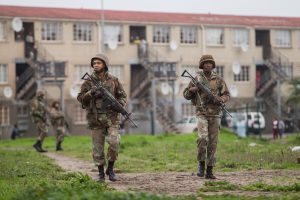 These images remind us why temporary military boots on the ground feel like a response, but the real hope lies in addressing the deeper issues so families can reclaim these streets without fear.
For residents in Manenberg, Valhalla Park, and the sprawling informal settlements like Xakabantu near Vrygrond, this has become a grim symphony. Just last night, WhatsApp groups buzzed with alerts: shots fired on Duinefontein Road, another barrage on Jessica Road, and the heartbreaking update of a young man gunned down, his life extinguished in a hail of bullets.
These aren’t isolated incidents; they’re the daily toll of gang wars that have turned neighborhoods into battlegrounds.
President Cyril Ramaphosa’s recent State of the Nation Address on February 12 brought a flicker of hope, or perhaps desperation. That’s when he announced the redeployment of the South African National Defence Force (SANDF) to the Western Cape’s hotspots, including the Cape Flats, to combat escalating gang violence. Soldiers, he said, would act as a “force multiplier” for the South African Police Service (SAPS), starting in the coming days alongside a similar push against illegal mining in Gauteng. This marks a return to the streets for the military, echoing the 2019 Operation Prosper, where troops patrolled amid a similar surge in bloodshed.
But as the dust settles on this announcement, a chorus of voices, from community leaders to crime experts, rises in dissent. The Cape Crime Crisis Coalition (C4) has outright rejected the move, calling it “a surrender” rather than a strategy. “The deployment of the army is not a solution; it is an admission that policing has failed,” the coalition stated in a scathing response. Even the Democratic Alliance (DA), while supporting a short-term deployment to stabilize high-risk areas, warns it’s no long-term fix for the deep-rooted failures of SAPS in the province.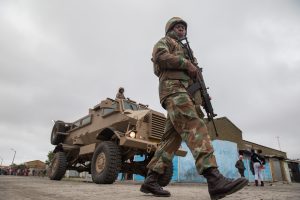
History backs their skepticism. During Operation Prosper, the initial presence of soldiers did curb murders briefly, reports showed a dip in the first month. Yet, as analysts like Dr. Guy Lamb from Stellenbosch University have noted, the overall homicide rate didn’t sustain a decline. Gangs adapted, going underground until the troops withdrew, only to resurface with renewed fury. Soldiers, trained for combat not community engagement, often strained relations with locals already wary of authority. “The SANDF is in freefall to obsolescence,” critiqued a recent Daily Maverick op-ed, highlighting the military’s own struggles with funding and readiness.
Beneath the calls for boots on the ground lies a question few dare to probe deeply: Where do all these guns come from? It’s the elephant in the room, fueling the endless cycle of violence. According to Acting Police Minister Firoz Cachalia, the surge in illicit firearms stems largely from diversion within legal markets, through theft, fraud, and straw purchases. A staggering 21,702 illegal guns were confiscated by SAPS over the past five years, with the Western Cape topping the list.
Many originate right here in South Africa: lost or stolen from licensed owners, pilfered from police stations, or even siphoned from state armouries.
Shockingly, state entities like the police and military are prime culprits. In a notorious case, former Gauteng police colonel Christiaan Prinsloo confessed in 2016 to selling thousands of firearms, including semi-automatics, to Cape Flats gangs. Robberies on police stations in the Western Cape alone yielded 38 assault rifles, 24 shotguns, and 32 pistols in just six months back in 1999, a pattern that persists. Cross-border smuggling adds to the arsenal: weapons trickle in from Zimbabwe, Mozambique, Eswatini, Lesotho, and Namibia, often stolen from their police or military stocks. One report traced over 90 seized guns to Namibian sources, smuggled via routes also used for illegal abalone trade.
Criminals exploit porous borders, online marketplaces, and covert couriers to keep the flow steady.
Dr. Lamb emphasizes that “the vast majority of illegal firearms circulating in South Africa are sourced from within the country,” debunking myths of exotic foreign influxes. This internal leakage points to systemic rot: weak controls, corruption, and a thriving black market tied to poverty and unemployment.
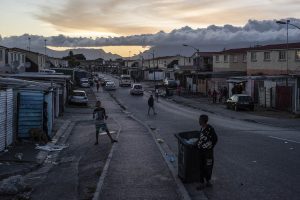 As one YouTube investigation put it, “a significant number of these firearms come from within the police environment itself.”
Picture a mother in Manenberg, barricading her door as night falls, knowing the army’s arrival might hush the streets for a spell. But when they leave? The guns remain, fed by the same unchecked streams. Deploying soldiers treats the symptom, not the disease. Real change demands intelligence-led policing, border fortifications, anti-corruption drives in SAPS, and investments in jobs, education, and drug rehabilitation to uproot the gangs’ hold.
As Parliament deliberates approval for this deployment, expected this week, residents wait, rifles at the ready on both sides. General Bantu Holomisa, speaking for the SANDF, says they’re “ready to deploy,” awaiting police details. But without addressing the gun pipeline and societal fractures, this could be just another chapter in the Cape Flats’ endless war story.
The Flats deserve rescuers, not just rifles. It’s time for answers that last beyond the next sunrise.
*I am a community advocate based in the west Coast. Views expressed are my own, informed by local insights and recent media reports.*