I AM ASKING QUESTIONS FOR HOPEFIELD”
With local unemployment deepening, community advocate says development could be a lifeline, but long-term consequences must be understood.
CCN Editor – George April
HOPEFIELD: There appears to be a growing perception in parts of the Hopefield community that anyone asking questions about the proposed Phelan Solar Project must automatically be opposed to it.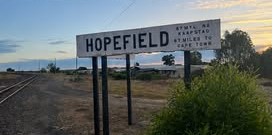 That is simply not the case.
For years, I have raised issues affecting the Hopefield community, particularly where employment, livelihoods, safety and the future of residents are concerned. Why would I suddenly oppose a project that could potentially become an important economic lifeline for our community?
My position is straightforward:
I AM NOT AGAINST THE PROJECT. I AM ASKING FOR CERTAINTY.
Hopefield is facing an increasingly serious employment crisis.
The situation surrounding the Elandsfontein mine has made this painfully clear. There are reportedly three subcontractors operating under Kropz, and one of the major contractors employing people from Hopefield has been unable to secure a new contract and is therefore facing closure.
Senior Kropz employees who live in Hopefield have also reportedly received retrenchment notices. This comes after workers were already suspended during the legal strike in June, leaving many families uncertain about what the future holds.
These are not abstract numbers – these are people from our community. And that is precisely why I believe we need to look very carefully at every opportunity for employment and economic development.
THE PHELAN PROJECT COULD BE A LIFELINE
If the proposed project can bring meaningful employment and economic opportunities to Hopefield, I would welcome that.
But I also believe we have a responsibility to ask the difficult questions before construction begins.
- How many permanent jobs will actually be created?
- How many will go to people from Hopefield?
- What qualifications will be required?
- Will residents receive training?
- What happens after construction is completed?
And perhaps most importantly:
Can we be confident that the project will protect our community’s water resources, existing economic activities, and residents’ safety for decades to come?
ASKING QUESTIONS DOES NOT MEAN OPPOSING DEVELOPMENT
There is a perception that raising concerns about groundwater, battery storage, agricultural land, distances from residential areas, or environmental impacts means someone is against renewable energy.
That is an unfair conclusion.
As a writer and community reporter, I understand that large developments come with both opportunities and risks. Our responsibility is to understand both. We should not allow political arguments, social-media campaigns or community divisions to determine the future of Hopefield.
Facts should.
WE HAVE ALREADY SEEN WHAT HAPPENS WHEN JOB SECURITY DISAPPEARS
The uncertainty surrounding the mine should be a warning to all of us. A community can become heavily dependent on one major source of employment. When that employment disappears, the consequences are felt throughout the entire local economy, by workers, families, small businesses and service providers.
That is why Hopefield must think beyond the immediate promise of jobs. We need to ask what kind of jobs are being created, how long they will last, and whether the development strengthens the community over the long term.
I WANT TO SEE HOPEFIELD WIN
I have always stood up when issues affect our community.
- I am not interested in preventing development.
- I am interested in ensuring that when development comes to Hopefield, our people are not left bearing the consequences while others reap the benefits.
If Phelan can provide employment, training and sustainable economic opportunities while protecting our water, environment, existing jobs and the safety of residents, why would I oppose that? But before anyone expects the community to support or oppose the project, residents deserve the opportunity to understand exactly what is being proposed.
LET’S HAVE THE COMMUNITY MEETING.
- Let the developers present the facts.
- Let independent experts explain the water and environmental implications.
- Let residents ask questions.
- Let the relevant authorities explain the regulations and safety requirements.
- And then let the people of Hopefield make an informed decision.
Not based on political point-scoring.
Not based on rumours.
Not simply because we desperately need jobs.
But based on the facts.
HOPEFIELD NEEDS THE LIFELINE.
WE JUST NEED TO MAKE SURE THE LIFELINE DOESN’T CREATE A NEW PROBLEM FOR THE NEXT GENERATION.
First the facts – then the decision.
