Is a new political conversation beginning in the Western Cape?
CCN Editor – George April
CAPE TOWN: The Inkatha Freedom Party (IFP) is not yet a major political presence across the Western Cape countryside.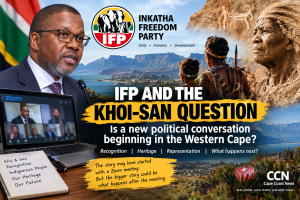 Its current 2026 election footprint in the province is concentrated in the Cape Town area, where the party is contesting the City of Cape Town elections. The Electoral Commission has certified the candidates for the 4 November 2026 local government elections.
But a recent development involving the IFP and representatives concerned about Khoi and San recognition has raised a question that could become increasingly relevant beyond the city.
A ZOOM MEETING THAT RAISED QUESTIONS
CCN has received a WhatsApp message forwarded from a Zoom meeting in which IFP President and Minister of Cooperative Governance and Traditional Affairs, Velenkosini Hlabisa, reportedly spoke directly to participants.
According to the message received by CCN, Hlabisa outlined what was described as the IFP’s vision and commitment towards Khoi and San communities.
The message further states that he encouraged participants to pursue recognition of the Khoi as Indigenous People.
CCN has not independently attended or recorded the Zoom meeting and therefore presents those details as information contained in the forwarded message.
But there is an important reason why the discussion deserves attention.
The IFP’s position on Khoi-San communities is not limited to this particular meeting.
THE IFP’S OFFICIAL POSITION
In its 2026 Local Government Election manifesto, the IFP specifically states that an IFP municipality would work with communities, traditional leaders and Khoi-San leaders.
The party’s manifesto also includes a commitment to protect traditional and Khoi-San institutions and leadership, including recognition, practical cooperation and what the party describes as a stronger rural voice. That places the Khoi-San question within the IFP’s broader local-government policy, rather than making it simply a matter of one political meeting.
WHO IS VELENKOSINI HLABISA?
Hlabisa is the current president of the IFP and South Africa’s Minister of Cooperative Governance and Traditional Affairs. That portfolio is particularly significant in this discussion because CoGTA deals directly with local government and traditional leadership.
The 2026 local government elections are scheduled for 4 November, with Hlabisa himself having gazetted the election date in his capacity as CoGTA minister.
BUT THERE IS A MUCH BIGGER STORY
The recognition of Khoi and San communities is not a new political issue. It has been part of a national conversation involving identity, representation, traditional leadership, culture and recognition.
For the Western Cape, the issue carries particular significance because of the province’s long Khoi and San history. And this is where the IFP’s current message becomes interesting. The party is historically associated with KwaZulu-Natal and with its founder, the late Prince Mangosuthu Buthelezi.
Today, under Hlabisa, the IFP is presenting itself as a national political party with a broader message around local government, traditional leadership and Khoi-San participation.
THE WESTERN CAPE QUESTION
The interesting question for the Western Cape is therefore not whether the IFP has suddenly established a major rural political structure.
It has not.
At this stage, the party’s visible 2026 electoral footprint in the province is centred on Cape Town. The more interesting question is whether its stated commitment to Khoi-San recognition and cooperation could eventually open a different political conversation in rural Western Cape communities.
That remains to be seen.
For communities who have long raised questions around Khoi identity, recognition, heritage and representation, however, the message from the IFP is something worth examining. Not as an election promise to be accepted without question.
But as a political position that deserves to be understood.
CCN’S QUESTION
- What exactly does the IFP mean by Khoi-San recognition?
- What would “Indigenous People” recognition mean in practical terms?
- How would such recognition fit into South Africa’s Constitution and existing legislation?
And perhaps most importantly:
What would it mean for Khoi and San communities in the Western Cape? Those are questions CCN believes deserve answers, particularly as South Africa moves towards the 4 November 2026 local government elections.
“The story may have started with a Zoom meeting, but the bigger story could be what happens after the meeting”
