Tibet Border; Hundreds Dead, Over 1,000 Missing
By CNN Staff
A catastrophic glacier collapse in the Himalayas triggered devastating flash floods along the Nepal-China border on Wednesday, killing at least 390 people and leaving more than 1,400 missing, according to authorities in both countries.
The disaster began early Wednesday morning when a large section of a glacier near Langtang Lirung peak sheared off and plunged more than 1,200 meters (about 4,000 feet) into the valley below. The collapse generated seismic waves equivalent to a magnitude 5.2 earthquake, according to the U.S. Geological Survey, which initially misidentified the event as a conventional tremor.
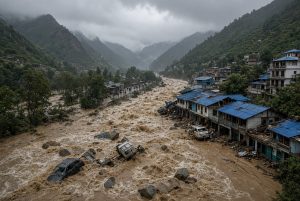
The falling ice and rock triggered a massive debris flow of water, mud, sediment and boulders that surged down the Lhende Khola, a tributary of the Bhote Koshi (also known as the Trishuli) River. Water levels rose by as much as 7 to 9 meters (23 to 30 feet) within 30 minutes in some locations, sweeping away villages, bridges, roads and hydropower infrastructure.
Videos circulating on social media and verified by news outlets show walls of muddy water engulfing streets, overturning vehicles and demolishing buildings in seconds. Survivors described hearing a roar like an explosion before the flood hit with little warning.
Casualties and Impact
Nepal’s National Disaster Risk Reduction and Management Authority reported hundreds of deaths and large numbers still unaccounted for, including foreign tourists and pilgrims traveling the popular route linking Kathmandu with Tibet. Chinese authorities said at least three people died in Gyirong County, with hundreds more missing, including more than 250 foreigners.
Critical infrastructure suffered severe damage. Several bridges and sections of the main highway were destroyed, isolating communities and complicating rescue efforts. Hydropower plants in the affected districts were also hit, raising concerns about power supply in the region.
Cause Confirmed by Scientists
Scientists analyzing satellite imagery and seismic data have confirmed the primary trigger was a glacial collapse, sometimes described as an ice avalanche. Experts from the University of Calgary and other institutions estimated that a roughly 2,000-foot-wide section of the glacier broke away from an elevation of about 5,200 meters.
“The ice just gets pulverized into water,” said one glaciologist involved in early assessments. The sudden influx of ice, rock and water temporarily dammed the river in places before the natural barrier gave way, releasing a powerful surge downstream.
The Himalayan region is warming faster than the global average, increasing the instability of high-altitude glaciers and raising the risk of similar events, researchers note. While it remains too early to attribute this specific collapse directly to climate change, scientists say the broader trend of glacial retreat and destabilization is clear.
Ongoing Risks and Rescue Efforts
Nepalese and Chinese authorities have warned that debris has formed temporary lakes that could burst, potentially causing additional flooding in the coming days. Rescue operations involving military helicopters and ground teams are underway, but difficult terrain, damaged roads and unstable ground continue to hinder access to some areas.
International aid organizations and neighboring countries have offered support as the full scale of the disaster becomes clearer. Officials expect the death toll and number of missing to rise as search teams reach more remote locations.
The floods have once again highlighted the growing vulnerability of mountain communities living downstream of rapidly changing Himalayan glaciers.