And Why Experts Say it Won’t Happen
CCN Reporter – George April
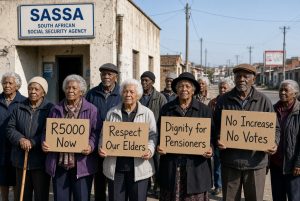
Across South African social media right now, one claim is everywhere: pensioners are about to receive a massive jump in the SASSA Older Persons Grant to R5,000 a month.
Posts, videos, petitions and protest footage circulate daily, and the figure has become a rallying cry for many elderly people struggling with food, electricity and medicine costs.
That followed an R80 increase announced in the 2026 Budget. No official decision has been made for any further significant top-up this year, and October adjustments in recent years have been tiny, often just R10.
Where the R5,000 figure comes from
The demand for R5,000 has been pushed hard by the Pensioners of South Africa (POSA) movement. In early September 2026 they organized nationwide pickets outside SASSA offices, arguing that R2,400 is no longer enough for basic dignity.
Petitions and online campaigns have amplified the call.
Politicians have also seized on the issue: EFF leader Julius Malema has publicly promised to raise the grant to R4,500 if his party gains power in the upcoming local elections. Other voices have floated similar large numbers. These promises land well with voters who are genuinely hard-pressed, but they remain campaign pledges, not government policy.
Why a R5,000 grant is extremely unlikely
Economists and official figures show the numbers simply do not add up under current fiscal conditions.
- Raising the grant for roughly four million pensioners into the R4,000-R5,000 range would cost the state close to R100 billion extra every year.
- Earlier government assessments put the full cost of a R5,000 grant at around R246 billion – almost the entire current social-grants budget.
- South Africa’s GDP per capita is still lower than it was in 2007. National Treasury has repeatedly signalled there is “no new money” for large new spending programmes without cutting elsewhere.
University of Pretoria economics professor Heinrich Bohlmann has been clear: an increase of more than about 10% looks improbable. The more realistic outlook for 2027 is an inflation-linked or slightly above-inflation rise – roughly R100 to R192 a month, depending on the exact model used. That is a far cry from the R2,600 leap many are hoping for.
SASSA itself has already flagged viral videos and messages promising a R5,000 grant (and other dramatic increases) as **fake news**. The agency does not set the grant amounts; those decisions go through the national budget process led by Treasury and approved by Parliament.
The political angle
The timing is not accidental. With local government elections approaching, the R5,000 demand has become useful campaign material. Parties can promise dramatic relief without having to explain how it would be funded or which other programmes would be cut. Critics call this exploitation of genuine hardship for political gain. Pensioners are left with raised expectations that official analyses say cannot be met.
The bottom line
Pensioners face real pressure from the cost of living. The R2,400 grant does not stretch as far as it once did. Peaceful protest and petitioning are legitimate ways to keep the issue on the agenda. But a jump to R5,000 is not on the table. No Budget document, no ministerial announcement, and no independent economic analysis supports it under present fiscal constraints. Expect, at best, small inflation-related adjustments, not the transformative increase flooding social media timelines.
For accurate information, the safest sources remain official SASSA and National Treasury channels rather than unverified social-media posts or campaign promises.
