South Africa Could Face It’s Most Unpredictable Political Shake-Up Yet
CCN Political Desk
South Africa’s political landscape could be thrust into unprecedented uncertainty, if President Cyril Ramaphosa were to accept internal pressure and resign.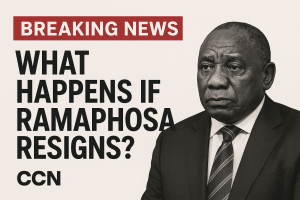 An option that has recently stirred speculation and fiery debate within the African National Congress, (ANC) and the wider Government of National Unity (GNU).
While Ramaphosa’s challenge to his detractors – “Give me the date and I will resign” was likely a defiant pushback rather than a genuine offer. The possibility of his departure raises several critical scenarios, that could reshape the country’s political future.
1.A Leadership Vacuum – And a Power Grab
Ramaphosa’s resignation would immediately trigger a power struggle inside the ANC, where factions have been quietly sharpening their knives.
A sudden vacancy in the presidency would intensify battles between:
Pro-renewal Ramaphosa loyalists
RET-aligned factions
Provincial power blocs seeking national influence
With no clear, uncontested successor, the ANC could become engulfed in its worst leadership war since the Polokwane split of 2007.
2. The GNU Could Be Thrown Into Chaos
The Government of National Unity, already a fragile arrangement between political rivals – rests heavily on Ramaphosa’s personal role as the balancing force holding parties together.
His resignation could lead to:
Renegotiation of GNU agreements
A walkout by smaller parties
Attempts by the DA to assert stronger influence
ANC disunity spilling into government operations
Without Ramaphosa, trust between GNU partners may collapse overnight.
3. Markets and Investors Could Panic
Like it or not, investors associate Ramaphosa with stability.
His exit could trigger:
Currency volatility
Sudden drops in investor confidence
Delays in major infrastructure and reform projects
Fear of policy reversals
South Africa’s economic recovery remains fragile; a sudden change at the top could disrupt months of progress.
4. A Snap Election Might Become Unavoidable
If the ANC cannot agree internally, or if the GNU crumbles, South Africa may face a snap election, a high-risk scenario last seen in deeply divided democracies around the world.
A snap election could lead to:
Coalition chaos
New political alliances
The possibility of the ANC falling below 40%
Smaller parties gaining unprecedented bargaining power
In such a scenario, the political map of South Africa could be redrawn entirely.
5. The Rise of a New President – But Who?
Several possible successors would emerge, including:
Paul Mashatile, the current Deputy President, though deeply contested
Gwede Mantashe, a party heavyweight with strong internal support
A compromise candidate acceptable to GNU partners
A technocrat figure, if the GNU demands stability over factionalism
Each option carries different consequences for governance, the economy, and coalition relationships.
6. Public Reaction: Relief, Fear, or Protest?
Ramaphosa’s departure would undoubtedly split public opinion.
Some may celebrate the end of what they view as weak leadership.
Others may fear the return of instability, state capture networks, or a more aggressive faction gaining control.
Civil society groups would likely mobilize, and the streets could become a key battleground for public sentiment.
A Turning Point and a Warning
If Ramaphosa resigns, South Africa could enter one of the most unpredictable political periods since the fall of apartheid.
His departure may not simply remove one man from office, it could dismantle the delicate structure holding government, the economy, and the ruling party together.
For now, his challenge remains just a challenge.
But if circumstances ever force his hand, the country must prepare for a political earthquake.
